
Agricultural spraying machines, whether sprayers or weed control units, owe the successful distribution of pesticides to a small but vital component: the nozzle.
The nozzle is the terminal on the machine that distributes the pesticide and converts the energy that the fluid possesses into kinetic energy. The nozzles, if well calibrated allow for minimal drift, that is, the plant protection solution not hitting the target.
Well-calibrating them, therefore, allows for both reduced economic expenses and potential risks to the environment and people.
What is the right nozzle for your farm machinery?
The nozzle, like any component in agricultural production, requires of the right choice in order to achieve the desired result by the farmer.
Its function of creating droplets of water/agropharmaceutical solution comes from its mechanism of producing droplets to be distributed on plants in order to carry out treatment.
The choice of nozzle depends on the type of application the farmer intends to make. In fact, for field crops there are a wide variety of nozzles that can be used depending on the types of treatments:
herbicides
fungicides
insecticides
For each of these categories, there are additional variables that intervene when contact treatments or systemic treatments are given.
This also applies to the choice of nozzles to be used on atomizers.
Commercially available nozzles
There are different types of nozzles on the market, depending on the mechanism, but four macro categories are generally given:
spray nozzles by pressure or hydraulics
pneumatic spraying diffusers
rotary nozzles (centrifugal pulverization)
atomizers or foggers (thermal spraying)
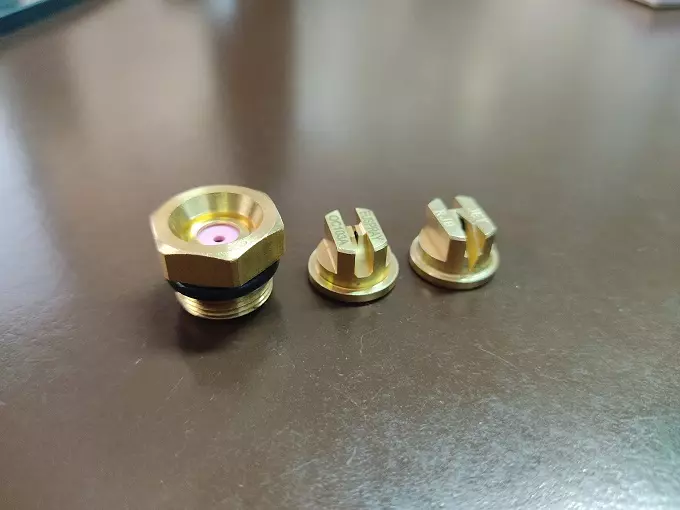
The hydraulic spray nozzle turns liquid into spray by passing the solution through spray tip. It is also divided into: threaded body, filter, spray tip and locking ring.
Its operation is simple: the greater the pressure, the smaller the outlet orifice, the finer the droplets distributed.
Several categories of these nozzles are found on the market:
slotted
turbulence
mirrored
full cone
The choice of these nozzles varies according to the type of crop, the amount of liters per hectare to be distributed, the speed of the tractor machine, the type of pressure and the type of treatment.
For the purpose of product distribution per hectare we will provide mathematical formulas, which are easy to understand, to better understand the choice of the right nozzle for one’s needs.
For atomizers
When controlling the liquid supply of the atomizer, it is important to pay attention to:
Q = amount of liter to be dispensed per hectare (lt/ha)
V = forward speed of the tractor (km/h)
D = distance between rows in meters.
Through these data, we can derive by mathematical formula the total flow rate (liters per minute) to be delivered, which we will denote by the letter T. Example:
q= 500 lt/ha
v= 5 km/h
d= 3 mt
600 = fixed number
500 *5*3/600 = 12.5 (T)
Dividing the result (in the example 12.5 T) by the number of nozzles used gives the amount of water and product dispensed per minute for each individual nozzle.
For more details see the attached table (source Arag):
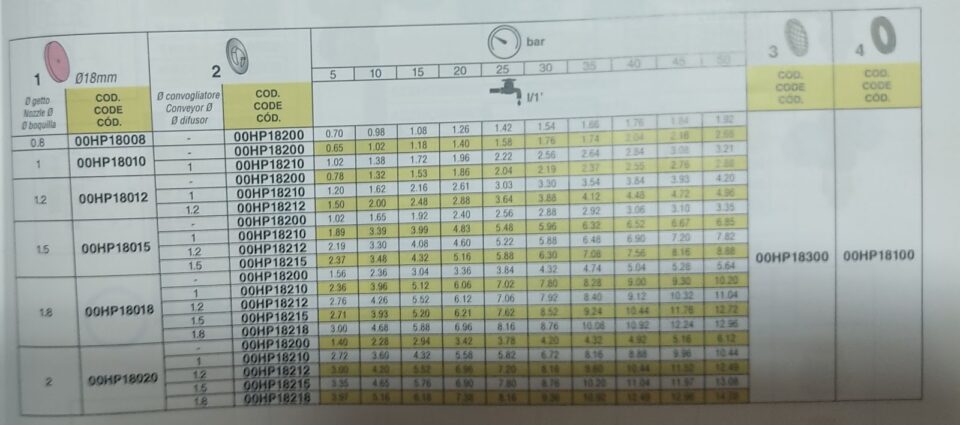
By virtue of this formula, the choice of nozzle will depend on the chosen operating pressure.
Herbicide groups also have a formula
If we want to obtain the liters per hectare that the sprayer distributes at a given pressure, at a given speed, and with a given type of nozzle, we must use the following formula:
Liters per hectare (lt/ha) = 60000*lt/min (per nozzle) all divided by kilometers per hour(km/h) and distance (L) in centimeters, between nozzles.
Example:
60000= fixed number
1.82= lt/m AITTJ60 nozzle at 4 bar (TEEJET anti-drift nozzle)
5 km/h=speed of the tractor
50 cm= L (distance between one nozzle and the other)
60000 *1.82/ 5*50= 436.80 lt/ha
If, on the contrary, we intend to calculate the gallons per minute of each individual nozzle, the mathematical formula to be used will be as follows:
Lt/ha*Km/h*L
_____________ = 500*5*50/60000= 2,08
60000
Data taken with bar height from the ground of 50 centimeters.
Pneumatic spray diffusers the spray is generated by the collision between the transmitted fluid and a high-speed air stream produced by a fan. The higher the air velocity, the finer the droplets will be.
Rotary nozzles consist of a by a toothed rotating disc that rotates by a motor while liquid is conveyed at low pressure to the center of the disc. Finally, the indentation of the disc contributes to the creation of the drops. Fineness is derived from the speed of the disk: higher speed creates smaller droplets.
In Nebulizers, or foggers, the mixture is pulverized by the stream of hot gases that are produced by combustion of a small engine.